

Meet Your Lecturers: Ryan Hayes on the Skills Needed for Employability, the Importance of Small Clubs and AI in Sport

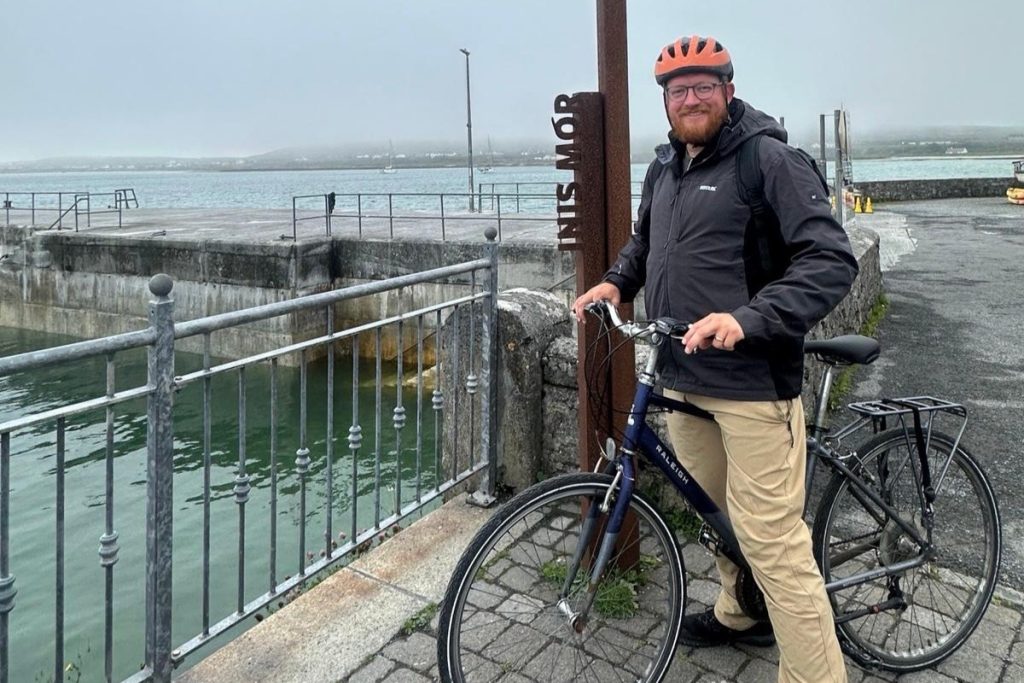
Course Leader for BA Sports Management, Ryan Hayes combines his experience in sports marketing and higher education to prepare students for careers across the sports industry.
Like most of our students, Ryan grew up surrounded by sport, before beginning his career in sports marketing and higher education, teaching a range of business and marketing programmes before joining GIS.
In the newest edition of GIS’ Meet Your Lecturers, we spoke to Ryan about the industry, discussing where students can improve the field of sports marketing, the importance of storytelling, and how the industry could evolve with emerging technologies such as AI.
Firstly, tell us a bit about yourself and your journey before GIS.
Well, I’ve always been a big sports fan. As a teenager, I played football and rugby, as well as being a brown and white belt in Shotokan Karate! I also dabbled in athletics, and at university level, I started playing American football as an offensive lineman.
Nowadays, I like to go on long walks in nature and, to make it a bit more challenging, I carry a set of golf clubs while I do it (some people would describe this as ‘playing golf’, but I personally don’t think I’m at that level yet). Outside of sport, I love travelling, reading and gaming.
I finished my Bachelor’s degree in English before getting a job in marketing and studying for my Master’s in Advertising and Marketing. Eventually, I decided to go into teaching, and from there, when I decided to take a career break and go travelling, I was offered the opportunity to work part-time at GIS as a module leader before eventually securing a full-time role as Course Leader.
If you could describe your programme in a sentence to prospective students, what would you say?
A community of like-minded students who are passionate about sport and learning all about its management in a flexible and online environment.
Having worked in both, are there any differences in marketing practice in and out of sport?
I think a lot of the same principles can be applied, but with a big asterisk next to some of them.
For example, when considering the environment within which we operate, we still need to consider a lot of the same aspects, whether they’re political, social or technological. Every industry needs to be aware of these and how they may impact the way in which they do business.
However, I think the biggest difference between marketing and sport marketing is how we think about consumer and fan behaviour. A lot of the theory behind consumer behaviour is that it often assumes a consumer is thinking rationally.
But as we all know, rational thinking can often go out of the window when it’s a team, athlete or sport we love.
Looking at the industry now, is there anything organisations are missing when it comes to sports marketing, and how can students capitalise?
I wouldn’t say anything is ‘missing’ as such, but I think some clubs and organisations perhaps get their priorities a bit wrong on occasion.
At the ‘elite’ level, we know that fans want more ‘authentic’ experiences but, in an increasingly ‘tech-savvy’ and cynical world, it’s difficult to offer genuinely authentic experiences at scale.
While this might be seen as a bit of a head-scratcher for those big global clubs, I think it also provides an opportunity to smaller regional or local clubs, who have more scope to offer those authentic experiences.
I think there’s also a lot of room in these environments for our students to use their skills and knowledge to improve things.
A couple of things I regularly see at smaller organisations are a lack of ‘funnel’ strategies, where social media and digital content don’t always seem to have an aim or objective, and a lack of engaging sponsorship activations, where clubs are selling logo placement instead of entering into partnerships.

For marketing students, what is the most important skill to have that they can bring to a potential employer?
There’s so many potential paths within marketing that it’s difficult to pick just one skill.
For students searching for that entry-level position though, it’s often good to position yourself as a bit of a ‘Jack-of-all-trades’ before specialising further down the line, whether that be content creation, data analysis/CRM, advertising or SEO.
That said, one skill that I try to drill into all of my students is how to construct narratives.
For me, sport and marketing are all about storytelling, so whether you’re writing a report or creating a slide-deck, the story you’re telling (and how you tell it) is key.
Another is people, people management is vital in any experience or role, particularly so in sport.
I think it’s really important for students to learn that you can still be a leader even if you’re not a manager, and you can still be a team player even if you’re a supervisor.
Finally, how do you see the future of sport marketing, and how will it evolve with the introduction of AI?
Personally, I believe there’s so much potential in Augmented and Virtual Reality and the sports industry has already seen some exploration in these areas.
However, I think until the technology becomes more accessible and widespread, it’s difficult to justify the investment into these kinds of experiences.
In terms of AI, there’s a lot of areas of sport marketing where this is already in use. AI can be a great tool for content ideas and prompts, but it can also be really useful for data analysis and pattern recognition.
In fact, there are some companies using AI to measure sponsorship and brand performance across social media platforms connected to major sporting events. It’s a really clever way of seeing how something like a shirt sponsor or advertising hoarding really gets a brand image ‘out there’ on socials, as well as providing a more accurate picture of sponsorship and media value.
That said, something AI is very bad at is emotional intelligence and this is key to marketing because, fundamentally, we need to be able to understand real people and real emotions.
Article by Zakaria Anani


You may also be interested in
Alumni
March 12, 2026 |
‘Your Network is Your Net Worth’: GIS Graduate on Beginning a Career in Football
Read Post

Latest news
January 6, 2026 |
The Global Appeal of Darts and Its Impact on the Sports Industry
Read Post
Latest news
July 23, 2025 |
Women’s EURO 2025 Breaks Records: Attendance, Prize Money, and Global Viewership Stats
Read Post
Our Partners