

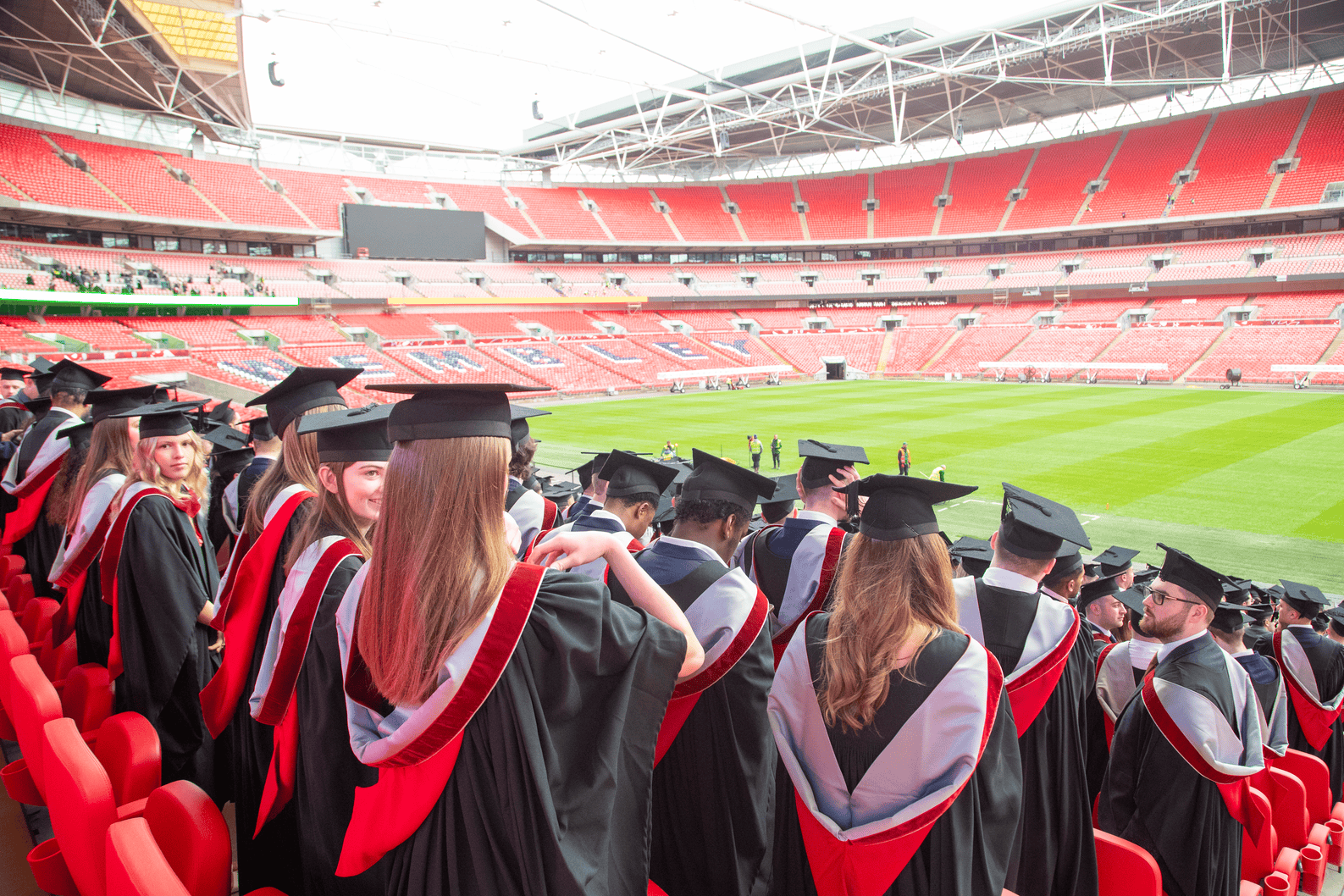

From Asia to Europe and to America, sport is a global phenomenon and supporters, participants and owners all play their part.

Course Information
Start Dates:
January, SeptemberDuration:
1 year full-time or 2 years part-time
Course Overview
Designed for ambitious graduates and industry professionals ready to take the next step in sport. This dynamic Master’s programme explores strategic, commercial and global forces shaping the sports industry. You will develop expertise in global strategy, marketing, communications, sponsorship, economics and much more. The course will challenge students to think about how organisations grow and innovate, giving them the skills to work in various roles across the global sports industry.
Recognised among the world’s leading sports business degrees, the International Sport Management programme was ranked in the top 10 online postgraduate sports programmes and the top 30 sports-related postgraduate programmes globally in the 2025 SportBusiness Postgraduate Rankings. This global recognition reflects the programme’s industry relevance, international outlook and strength in preparing students for careers in the business of sport.

The Global Institute of Sport has once again been recognised among the world’s elite, achieving major accolades in the SportBusiness Postgraduate Rankings 2025.
#1 ranked UK university for career advancement
#1 ranked online programme for career advancement
#1 ranked globally for quality of faculty
#1 ranked globally for industry network


Course Content
You will explore the global business of sport, from how leading organisations build their brands and connect with fans to how clubs, venues and governing bodies make strategic, financial and commercial decisions. Covering areas such as international sport strategy, sponsorship, marketing, digital communications, finance, consultancy, operations and sustainability, the programme gives you a broad understanding of what it takes to succeed in the modern sports industry. With a strong focus on applied learning, you will work on real-world challenges and develop the insight, creativity and professional skills needed to solve problems and make an impact in global sport.
This programme is taught entirely in English.
Teaching Location
Study a degree from anywhere in the world, with flexible learning options to suit your schedule. With GIS, you’ll unlock access to a global network of students, alumni and industry professionals to maximise your opportunities and excel in the most exciting industry in the world.

Modules
Students studying on UEL-awarded programmes are subject to UEL’s academic regulations. These set out the rules for academic matters such as assessment, marking, progression, reassessment, academic misconduct and appeals. The regulations are available on the UEL website.
This module explores how sports organisations develop and manage effective global strategies in an increasingly complex and competitive environment. Students will analyse the macroenvironment (e.g., economic, political, and cultural forces) and the microenvironment (e.g., industry dynamics and stakeholder relationships) to understand external influences on strategic decision-making. Core topics include business and corporate strategy, focusing on how organisations position themselves competitively and manage multi-level operations. The module also examines international strategy, with an emphasis on global expansion, market entry, and adaptation. Students will explore the role of entrepreneurship and innovation in driving growth, particularly through digital disruption and emerging trends in sport. Strategic growth through mergers, acquisitions, and alliances is evaluated alongside the broader strategy development process, from formulation to execution. Finally, the module addresses how to organise and evaluate strategy, and the critical role of leadership, governance, and strategic change in ensuring long-term success in global sports organisations.
This module provides a comprehensive overview of the key economic and financial principles shaping the global sports industry. Students will explore foundational concepts such as market structures, competitive balance, and labour economics, while gaining insight into how sports clubs and organisations generate and manage revenue through ticketing, sponsorship, and media rights. Furthermore, the module examines the financial implications of public stadium funding, investment decisions, and the regulation of spending through frameworks like Financial Fair Play. Students will also learn to interpret financial statements, assess risk, and understand the unique challenges of budgeting in both commercial and non-profit sport settings. In its final weeks, the module looks ahead to the future of sports finance, exploring technological disruptions, digital assets, and sustainable investment models. Combining theory with real-world case studies, this module equips students with the tools to critically analyse and apply economic and financial strategies in a dynamic sports context.
This module explores the dynamic and evolving landscape of global sports marketing and digital communications, equipping students with the strategic tools to operate effectively in international markets. It begins by developing skills in international sports marketing research and consumer behaviour analysis, with a strong emphasis on cultural awareness. Students will learn how to segment and target global audiences, select appropriate market entry strategies, and build impactful sports branding and product strategies tailored to diverse markets. The module also covers global approaches to pricing, distribution, and promotional tactics, integrating both traditional and digital platforms. A focus on digital communication explores how to optimise social media, content strategy, and customer relationship management (CRM) across the customer lifecycle. The module culminates in the creation of a comprehensive global sports marketing plan engaging fans, which enables students to apply their learning to real-world strategic planning, execution, and performance evaluation in the global sports industry.
This module provides an opportunity to undertake an applied professional project that bridges academic learning with real-world practice in the sports industry. It is designed to enhance your professional skills, critical thinking, and problem-solving abilities by engaging with a current issue or challenge within a sporting context.
You will take ownership of a sustained, independent project that draws on the knowledge, competencies, and experiences developed throughout your programme. Working within a live or simulated sports environment, you will apply theoretical understanding to practice, with the aim of generating meaningful insights or solutions that have direct relevance to coaching and performance, or sports business and management, marketing or media.
The module fosters experiential learning by encouraging reflection on your personal development and professional impact. Through this process, you will demonstrate leadership, initiative, and the ability to manage and deliver a project from conception to completion, all of which are highly valued by employers in the sport sector.
Your chosen project will allow you to explore an area of personal or professional interest, showcasing your ability to integrate academic knowledge with industry practice. By presenting your findings and outcomes, you will contribute to the enhancement of professional standards and demonstrate your readiness to influence and improve sporting environments.
This module provides students with a comprehensive understanding of management consultancy practices in a global context. It begins by exploring the fundamentals of project management and the importance of clearly defined team roles and responsibilities in achieving client objectives. Students will develop skills in stakeholder management, learning how to engage and influence key decision-makers across diverse organisational settings. The module also delves into talent management practices, highlighting strategies to attract, retain, and develop high-performing individuals within consulting teams. A focus on dynamic performance measurement systems equips students to assess project outcomes effectively, while the study of control and communication mechanisms ensures clarity, accountability, and alignment throughout the consultancy process. Emphasis is placed on building effective client-consultant relationships, underpinned by trust and credibility. Finally, the module integrates principles of equality, diversity, and inclusion, preparing students to deliver ethical and culturally competent consultancy services across global markets.
This module is focused on sport facility operations management and how organisations in the sports industry can implement sustainable development policies to make their decision-making process more efficient. The module covers a wide array of topics including sport facility management, event management principles, crowd safety techniques, sustainable development policies, the role of sport in the community, social identity and sport, and the added value of sustainable practices for sport organisations.
You will be introduced to academic theories which will be related to case studies from the global sports industry. You will be expected to critically explore academic theories, governance regulations, and industry practices related to the content of this module.
The module will help you to explore, interpret and apply operations management principles and consolidate these into long-term sustainable strategies for a sports organisation.
Meet your
Course Leader
Craig Hopkins
Craig is a Senior Lecturer in Sports Business at the Global Institute of Sport, an experienced sports professional and educator with expertise in sports business, leadership and sports marketing. Drawing on his experience as a professional basketball player, coach and sports development professional, he delivers industry-focused teaching that equips students with the commercial knowledge and practical skills needed to succeed in the global sports industry.
Sam Swanton
MSc International Sport Management graduate
Head of Commercial, Salford City

Entry Requirements
- Undergraduate degree – minimum 2:2 (ideally a 2:1) or international equivalent.
- Applicants should demonstrate any experience and a passion for sport in their personal statement.
- English Language Requirements: if you’re applying from a country where English is not the majority spoken language, you’ll need to demonstrate your English proficiency. We accept a range of internationally recognised qualifications, with the minimum standard being: IELTS score of 6.5 overall, with no individual component below 6.0, or an equivalent. Accepted qualifications include: IELTS Academic, IELTS for UKVI, TOEFL iBT, Oxford ELLT, PTE Academic, Cambridge IGCSE, ESOL, and IESOL.
- Oxford ELLT is fast, online English Language Level Test, preferred by Global Institute of Sport that can be used as evidence of a candidate’s English language proficiency for international admissions. Visit the Oxford ELLT site.
- We require a minimum ELLT score of 7, with at least 6 in each individual component.
Offers to applicants currently studying an undergraduate degree will be conditional on them going on to achieve the entry requirements on completion of their degree.
Flexible Entry Requirements: Applications that do not meet the standard entry requirements but demonstrate relevant education and/or work and/or life experience in the course subject area are welcomed.
Eligibility will be assessed on the basis of the information provided in the application – in particular the personal statement.
- Application form
- Evidence of highest academic and/or professional qualifications
- Evidence of relevant experience, where required
- 500 word personal statement
Applications made through the flexible entry route may require a course leader review. The course leader will determine whether a professional reference or task is required.
Scholarships
The Global Institute of Sport is proud to offer an extensive suite of scholarships to support outstanding students as they embark on their postgraduate study. From scholarships to aid our elite athletes, to attracting aspiring sports leaders, and scholarships which support inclusivity and diversity within the sporting industry, our scholarships are there to support students who want to make a meaningful difference to the future of the sporting world.

Career Prospects
The global nature of sport requires professionals who can lead across borders, manage diverse teams, and respond to the evolving commercial landscape of the industry. This programme is designed for those aspiring to senior roles in sport governance, club management, marketing, and international operations. Graduates of the MSc International Sport Management degree have gone on to work in roles for organisations such as:
- DAZN – Campaign Executive
- Nike – Sports Marketing
- Arsenal FC – Sales Coordinator
- West Ham United – Marketing Assistant
- Premier League – Academy Player Care Manager
99 %
of our postgraduate graduates are either employed or in full-time study
Graduate Survey 2024
79 %
are working or studying in sport
Graduate Survey 2024

Fees
These fees are for the 2026/27 academic year and are subject to annual review.
Find out more about your funding and finance options.
Students studying on UEL-awarded programmes pay their tuition fees to the University of East London, not to GIS. UEL’s Student Fees Policy explains how tuition fees are charged and administered, including payment, fee liability and refund arrangements. The policy is available on the UEL website.
These discounts are open to any GIS, UCFB, Vrije Universiteit Brussel and University of East London graduate who has received and accepted an offer to study at the Global Institute of Sport.
15% fee tuition discount on all Master’s programmes.
- IT Devices – Students are expected to have access to a laptop or computer from which they can access recorded content or live sessions. The device(s) used should be capable of streaming video content, accessing documents and using the internet. Students will be expected to have access to a stable internet connection, particularly for live session access. Students who study on finance modules would also require a calculator or app. If you are unsure as to whether or not your device is suitable, please contact assistance@gis.sport for advice.
- Books and Materials – When designing our courses, we make use of learning resources and books available to you through the UEL Library – you do not need to purchase, rent or pay for additional materials in order to meet the learning outcomes of the programmes.
- In person events – As an online institution, many of our events are held online and can be accessed with suitable IT Devices (see above). Where events are held in-person at one of our locations, they are entirely optional and attendance will not be required in order to complete the programme. Additional costs of any such events will be published with the event information.
- Graduation – Students who wish to attend any graduation or celebration events at GIS may need to pay an event attendance fee to secure their tickets or pay third party vendors for photos and attire. These events are optional and attendance is not required in order to receive an award. The costs of attending these events will be published when announced.
- Resits & Retakes – A resit is a second attempt to pass an assessment where the first attempt has been failed or not attempted. Where students are entitled to an assessment resit, this opportunity will not come at an additional cost. Where a student is required to retake failed module(s), in order to progress with their course, a ‘retake’ is an additional attempt to undertake the module(s) in full, engaging in the module(s) teaching learning and assessment as a student from the start. Under UEL regulations, students are required to pay for the retake in full, based on the fees quoted in your offer letter.
- Certificates and Transcripts – Students receive one free copy of their final certificate and transcript. If a student requires additional or replacement copies for any reason, UEL may charge a fee in line with its published arrangements.
Study on campus in Sydney, Miami, Toronto or Brussels




Looking to study on-campus in the UK?
Check out our partners University of East London (UEL) for more information.
