

‘Football was a language everyone already spoke’: John Savage’s Journey from U.S. Army to GIS

Spending nine years in the U.S. Army, John Savage’s job took him around the world. Working across Africa, the Middle East, Europe and Central America, each region had different cultures and languages, making it difficult to communicate and connect with locals. Football was the exception, or, as he described to GIS, “the language that everyone already spoke.”
Working as a Logistics Officer, John coordinated global logistical support for international training missions and combat operations as part of his role, one he began in 2017 and left in 2026 after beginning his postgraduate studies in MSc Performance Analysis in Football.
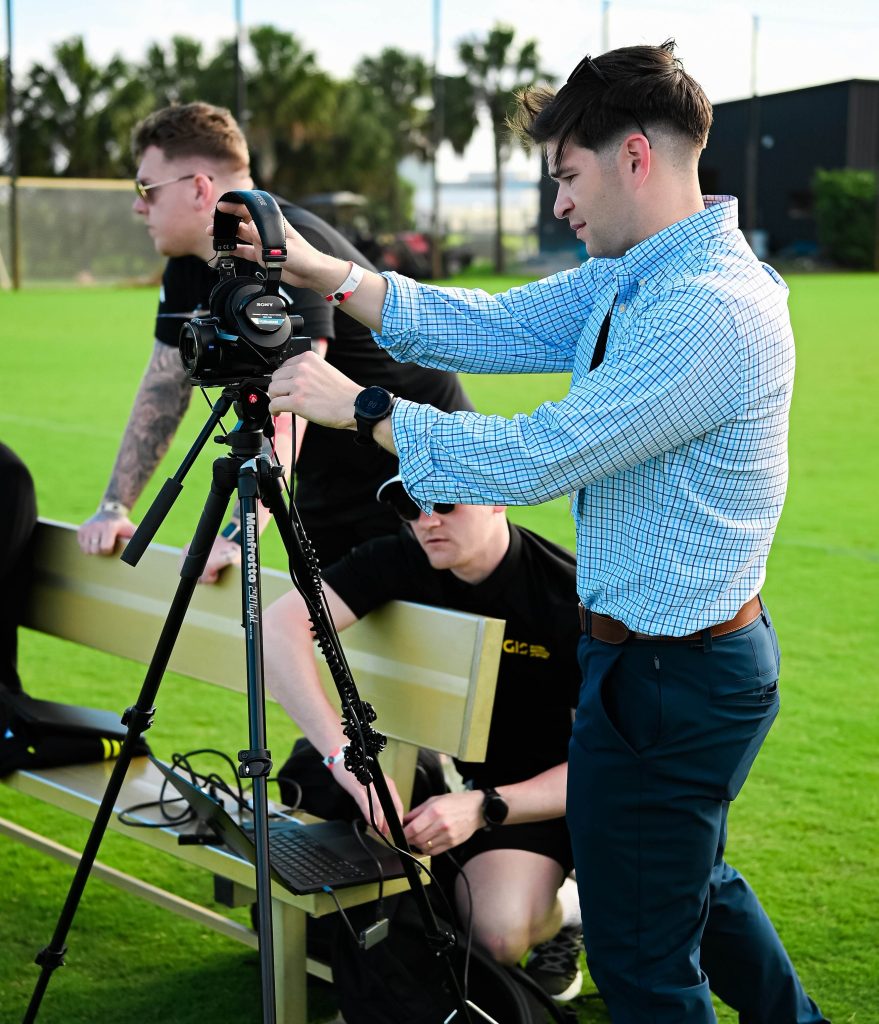
Having always loved playing football, his route into working in it came, in his words, “almost by accident.”
“At my last assignment, a fellow soldier’s son played for our local club, and he suggested I give coaching a try. I’d always loved playing the game, but what I discovered I loved just as much was mentoring and teaching it.”
Referring to Savannah United in the U.S. state of Georgia, John began coaching in the youth academy, and is now part of the U17 set-up at the club.
With a keen desire to understand the game on a deeper level, his attention then turned to performance analysis. “I wanted to see how PA (Performance Analysis) was shaping the modern game,” he explained.“The degree did more than inform me, it challenged how I thought about the game entirely, revealing just how nuanced performance is at both the individual and team level.”
After enrolling on the programme with GIS, John discovered the amount of expertise needed as part of an analyst’s role, emphasising that, from the outside, he had underestimated “how many disciplines a good analyst has to be fluent in at once: data, statistics, video software, video telestration, data visualization, synthesizing all of it into something usable, and then communicating it clearly to players, coaches, physios, psychologists, scouts, and sporting directors.”
Nevertheless, John very much sees the role as a rewarding one. “What I enjoy most is hearing players’ stories, everyone comes from somewhere different, and everyone plays for a different reason. Watching a player grow over a season, watching their self-belief build, is genuinely fulfilling. I’ve always believed that if I made a player a better person, I did my job, regardless of what the scoreline said.”
Aiming to build experience in youth football for a future in the professional game, John laid out three of the most important lessons he has learned about his discipline: time management, critical thinking, and the value of personal relationships.

“Time management matters because both coaching and analysis are high-pressure, low-turnaround work, you get a small window to prepare a team for the weekend,” he began.
“Critical thinking is the framework underneath everything, because so much of football is processing information at speed and making the best decision available in the moment.” He continued to explain that this exists at the “micro-level”, referring to a moment within a match, and the “macro level”, which takes the broader example of a season-long development plan.
“That same skill drives academic work, analysis projects, talent identification, and how I plan training sessions,” he added, on the balance between academia and the practical side of his role.
Then, he moved onto his third lesson: “Relationships matter most of all.
“Being genuine, and showing real care for teammates, peers, and fellow coaches, pays off in ways you can’t always predict. There will come a point where you don’t have all the answers, or you need help with a project, a connection, or advice, and it’s those relationships that carry you further than anything else.”
With one semester to go at GIS, John’s aims are to build on the experience he’s developed, which have included multiple coaching qualifications as well as an analyst role with GIS partner Mount Pleasant Football Academy.

“My goal now is to combine coaching and performance analysis into one career, ideally starting at the youth level and progressing into the professional game. Working in the English Premier League would be a dream for an American.”
“My best advice to anyone considering this path is to jump in with both feet. It’s a challenging program, but you come out of it understanding a lot more about yourself, and about what you truly love about sport.”
Article by Zakaria Anani


You may also be interested in

Latest news
December 9, 2024 |
The true size of the global sports industry
Read Post

Latest news
July 3, 2026 |
GIS President Sharona Friedman Appointed Chair of Independent Higher Education
Read Post

Latest news
September 11, 2025 |
Inside Event Management at the World Cup: ‘Relationships Were Tested Hourly’
Read Post
Our Partners