

Sponsorship and Sustainability: The Role of Independence and Multi-Club Ownership in the Growth of Women’s Football
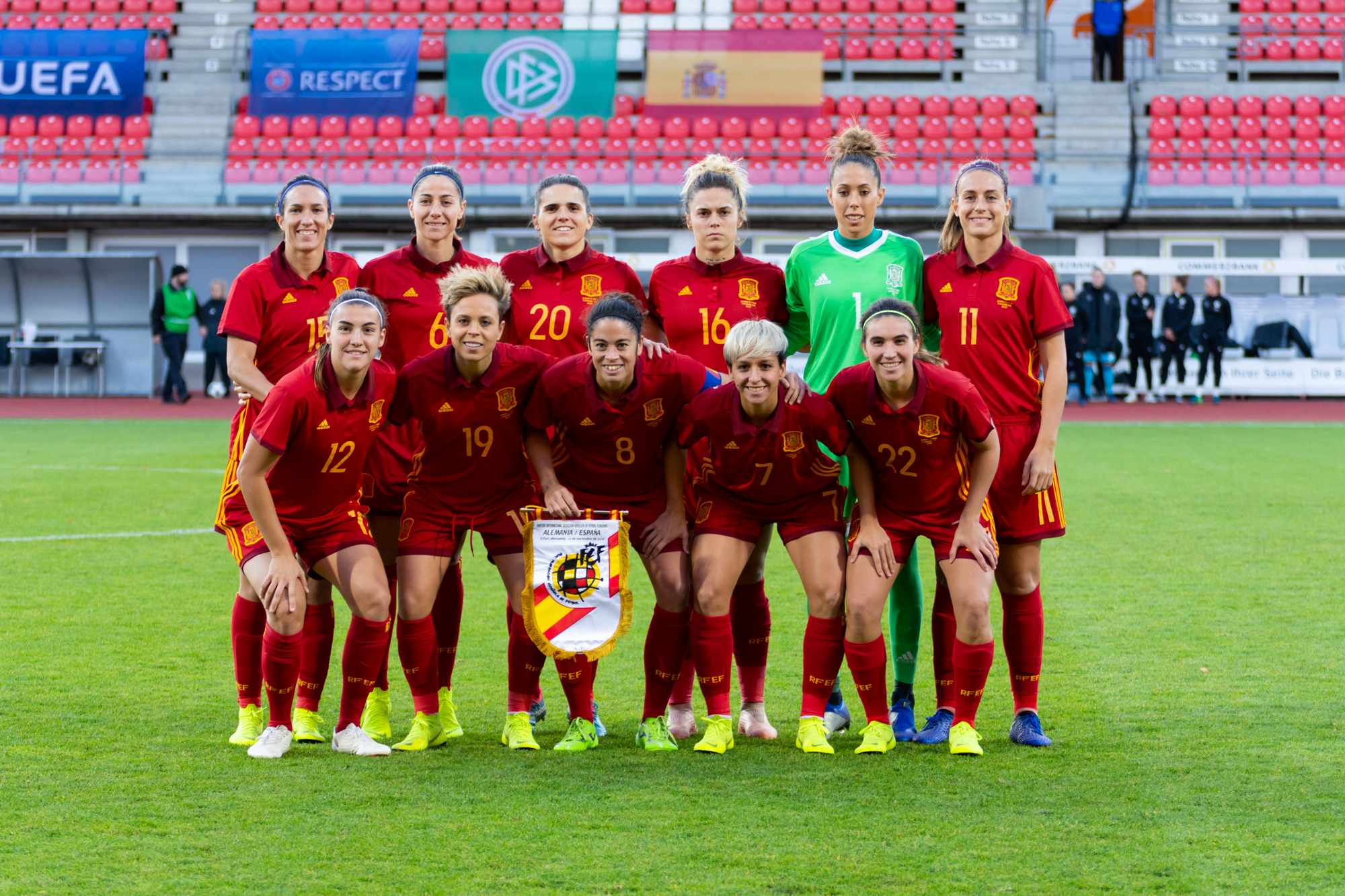
Spain women’s national team vs Germany in Erfurt, November 2018” by EL Loko, licensed under Creative Commons Attribution 4.0 International (CC BY 4.0), https://creativecommons.org/licenses/by/4.0/; image from Wikimedia Commons.
Recent record-breaking tournaments have shown that there is a rapidly growing appetite from fans to watch women’s football.
This includes a 3.5 million viewership count for England’s 2025 Euro opener against France, and an attendance of 38,000 for the 2025 Champions League final between Arsenal and Barcelona.
The eyeballs on the product that is women’s football offers sponsors an investment opportunity, which is becoming increasingly lucrative as clubs and organisations are becoming less-reliant on their male counterparts.
Analysing case studies and expert-interviews, this article will discuss how women’s football having more autonomy over its own product will pave the way for a more sustainable, focused future, as well as discussing the impact that Multi-Club Ownership (MCO) can have on the growth of the women’s game.
The Rise of the Standalone Model: An Incentive to Sponsors
In 2019, London City Lionesses were formed after splitting from Millwall Lionesses to become their own entity.
Competing in the Women’s Championship at the time, the club was taken over by Korean-American businesswoman Michele Kang in 2023, before earning promotion to the Women’s Super League (WSL) earlier this year.
This made them the first and only fully independent club to compete in the division. So what do we mean by ‘fully independent’?
In women’s football, particularly in Europe, the majority of clubs are attached to a men’s team, and this tends to be where the investment comes from.
When splitting from Millwall Lionesses, the Chair of London City Lionesses stated: “A club of this size needs proper support—financial and otherwise. The women’s game can no longer be treated as an afterthought.”
This is often the case as funding can rise and fall depending on the success of the men’s team. However, London City Lionesses are a case study for how self-governance can be the future of the women’s game.
This independence allows the club to craft its own identity and have control over every aspect of how it operates.
Doing so gives the organisation its own product that it can sell to sponsors. Recently, London City Lionesses partnered with Nike, and Kang said: “With shared values at the core, this partnership puts female athletes front and centre—across both performance and training apparel—to help elevate their game.”
Media company Togethxr is another sponsor of London City Lionesses. In recent months, their Everyone Watches Women’s Sports slogan was worn by players as part of a campaign supported by NBA star Steph Curry and actor Jason Sudeikis, earning the company around $6 million in revenue.
Co-founded by former Tottenham striker Alex Morgan, the company is based in the US, where independent clubs and leagues are the norm and the women’s game is built around a women-first approach.
A Proven Model: How the NWSL Balances Growth and Stability
The National Women’s Soccer League (NWSL) is the highest level of women’s football in the United States, and has a history of financial sustainability being top of the priority list.
The league, which signed a $240 million broadcast deal in 2023, operates a franchise model and currently enforces a salary cap that it, as a standalone organisation, has complete control over.
This is an approach praised by GIS Board member and former Sunderland AFC Executive Director Charlie Methven, and is one that NWSL Commissioner Jessica Berman believes is “vital for the league’s competitive balance.”
The organisation is even taking a sustainable approach to upscaling, adopting a ‘rolling’ expansion model that doesn’t commit to deadlines for new franchises and prioritises the long-term health of the NWSL. For the 2026 season, the league will increase from 14 to 16 teams, with the two new additions paying a $53 million entry fee.
Prospective sponsors looking at the league, which also partners with Nike, will see a product whose viewership has risen by 5% in the last year, as well as a fanbase increase of 9 million people since 2023, according to a report by Nielsen.
Nielsen has also reported that the market for women’s football is a particularly lucrative one.
Their key findings include that the global fanbase is projected to grow from 500 million to over 800 million by 2030 and that the 2023 FIFA Women’s World Cup reached a media engagement audience of 2 billion, while sponsorship deals tripled compared to 2019.
It has been well-documented that a large audience is an incentive for companies deciding whether or not to invest in women’s football, but the value of the audience to sponsors itself is understated.
The same report found that by 2030, 60% of fans will be female. This is significant as it is said that by 2028, women are expected to control 75% of household purchasing decisions, “underscoring the urgency for brands to act.”
47% of the fans are among the top global earners, and 50% are between 24-44 years of age, one that Nielsen notes is a “prime commercial demographic.”
Overall, these statistics highlight not only the capacity of women’s football to draw viewers, but also its economic power, leading Rebecca Smith, former New Zealand captain, to say via the Business of Sport podcast that “The women’s game can and should be bigger than men’s football.”
The Rise of MCOs in Women’s Football, and Why It’s a Reason to Invest
As well as a successful playing career for VfL Wolfsburg, Rebecca Smith is the founder and CEO of ownership group Crux Football.
Acquiring Montpellier HSC Féminines earlier this year, Smith says the group has plans to “acquire quite quickly and expand quickly” to become an MCO group.
Referencing data analytics and commercial departments, Smith explained the reasons for why the MCO model can allow each club within it to build the best possible environment for success. On the Business of Sport podcast, she said: “You can’t do those things [have the best departments] if you only have one club.
“But, if you spread those costs over five teams…that becomes quite a financially sustainable model, and you can now sell across a European offering”
This “European offering” is the link back to the sponsors in question, with Smith adding: “If we buy clubs across Europe, you can now be involved as a partner/sponsor/fan in something that is Europe-wide.”
Kang, who is also the majority shareholder at both OL Lyonnes and Washington Spirit, is also an advocate for this, seeing multi-club ownership groups as a “necessity, not a luxury, or greed.”
Independence to Grow the Women’s Game
Overall, it is widely accepted that women’s football has the potential to boom. Among many in the industry, it is felt that to fulfill this potential, the clubs and organisations have to take control of their own identities and operations if they are to become financially sustainable.
Industry expertise and education are vital for the professionals working towards this. This includes many GIS students and graduates, with Methven saying: “As our industry matures, it constantly needs better access to better qualified people, and that is what GIS is now providing through courses which combine a unique mix of academic credibility and hands-on experience and connectivity.”
To discover our courses, expertly designed to give you the knowledge and network needed to work in the sports industry, visit our programme page.
Article by Zakaria Anani


You may also be interested in

Latest news
August 8, 2025 |
Back-to-Back: How the Lionesses’ EURO 2025 Win Impacts the Sports Industry
Read Post

Latest news
March 11, 2025 |
The True Size of India’s Sports Industry
Read Post

Student Profiles
October 8, 2025 |
‘A Training Ground for Leadership’: Mmamoagi Kungoane on GIS Elite Athlete Scholarship
Read Post
Our Partners